
Work Musings · GTM AI
Is your company AI-native?
Now a harder one. Is that mostly because every rep has a Claude or Codex license?
That was us too. Two years ago, AI in go-to-market at Canva was one person in ops with a Clay table.
I presented this at Sculpt this year. I thought I’d post it here too, for anyone who couldn’t be in the room.
It’s the story of how we got from there to here, drawn as a curve with four stages.
By the end, you should be able to point at the curve, say “that’s us,” and know what your next stage needs.
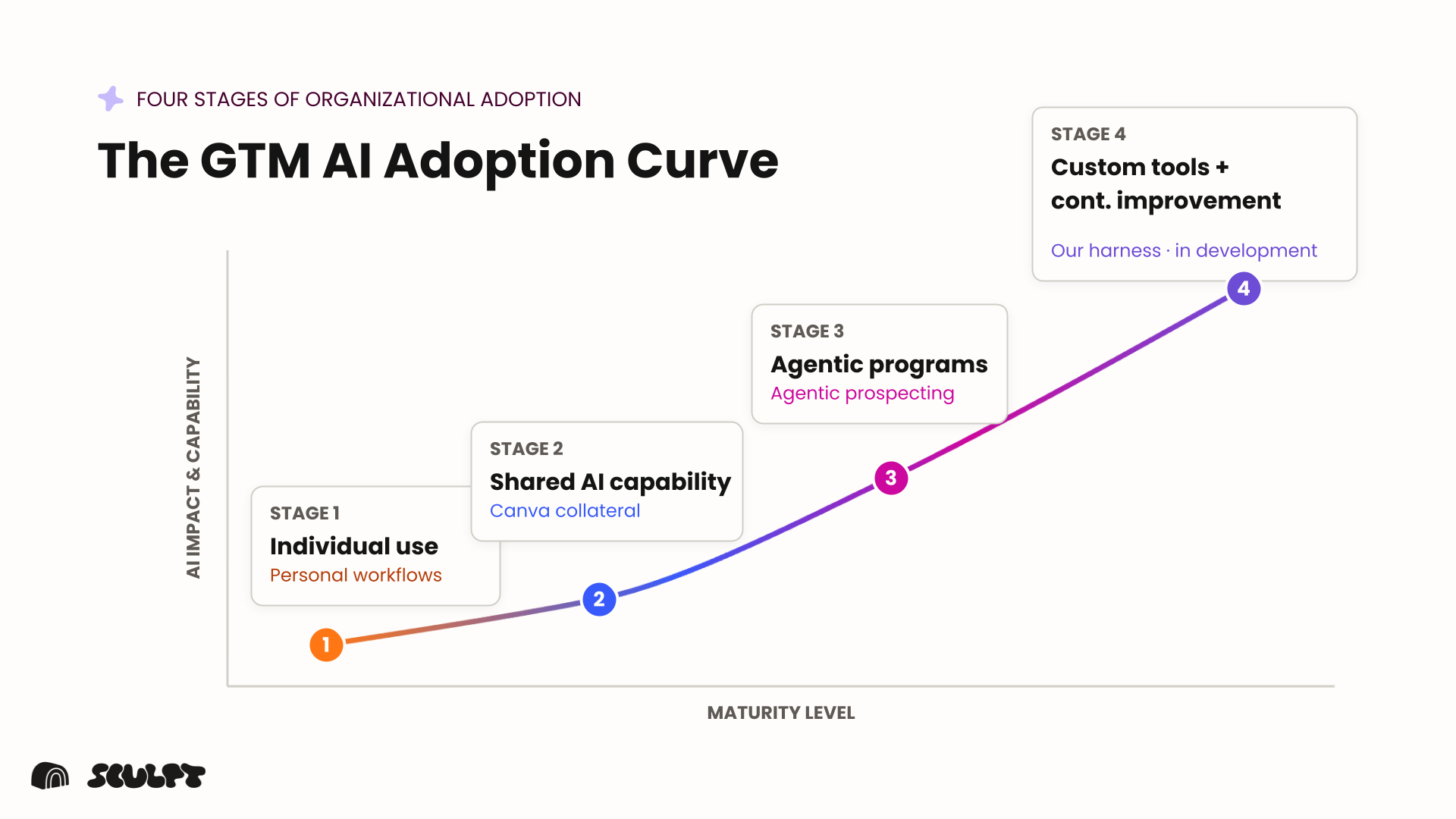
The whole curve. Not yet trademarked, so use it while you can.
The curve tracks the team, not the individual
The curve tracks how a go-to-market organization adopts AI, not how one clever rep does.
Stage 1, individual use: reps build their own personal workflows.
Stage 2, shared AI capability: skills, connectors and company knowledge, built once for the whole team.
Stage 3, agentic programs: agents run a defined motion, like prospecting.
Stage 4, custom tools and continuous improvement: you own the software, so you can measure the work and improve it.
We’ve been working through these seriously for about a year. It didn’t happen overnight.
At each stage, I’ll cover what worked for us and the trap I’d watch for.
Stage 1: a license is not a strategy
Stage one is really an assessment. You can’t roll out an AI strategy until you know where your reps are, because your reps are your customers.
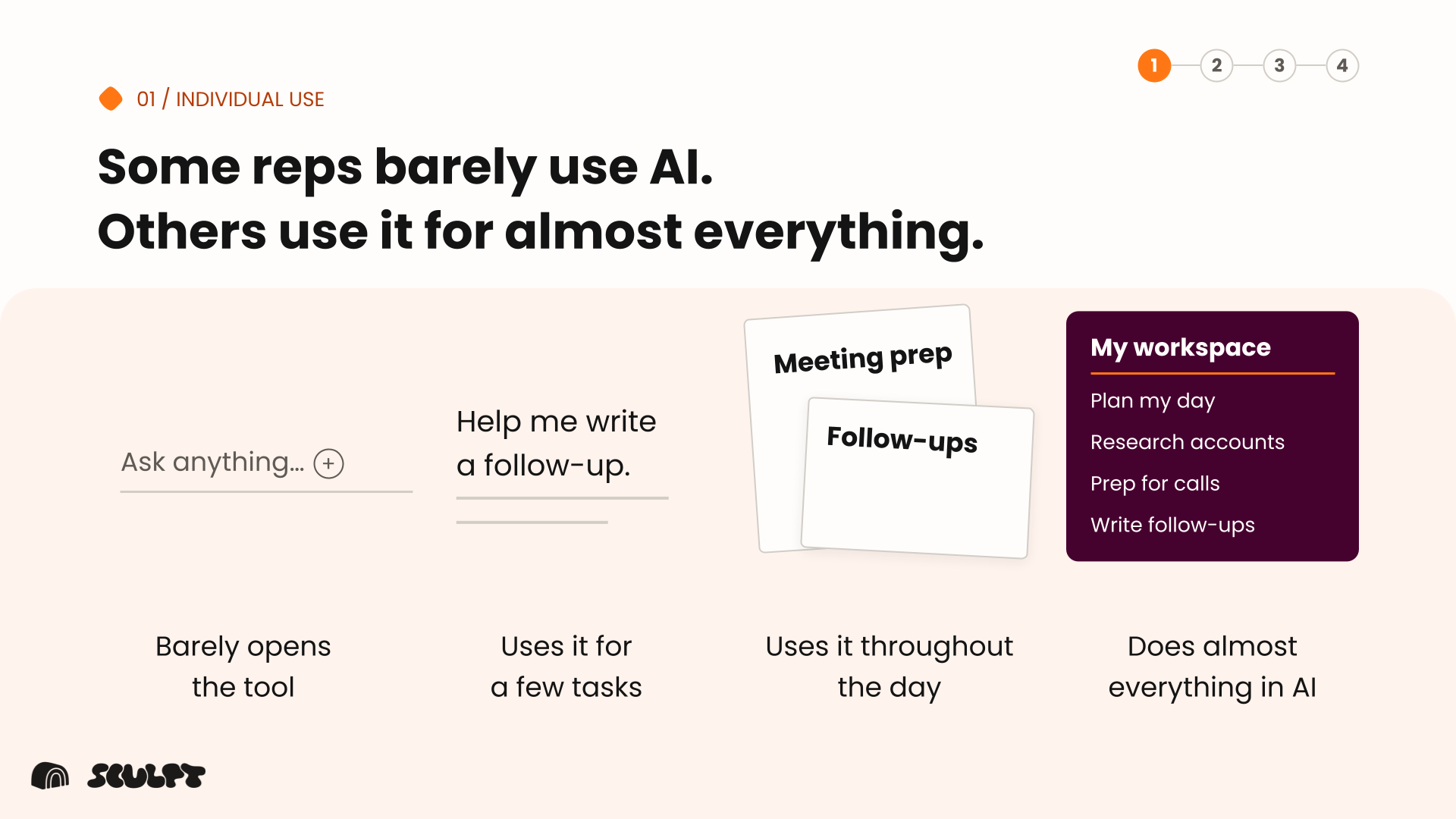
Know who is where before you plan anything.
You’ll see a huge range. Some reps barely open the tool, and others do almost everything in AI.
That second group is also the one costing you a lot of money.
The trap at this stage is the one I opened with: calling yourself AI-native because every rep has a license.
Stage 2: build it once for the whole team
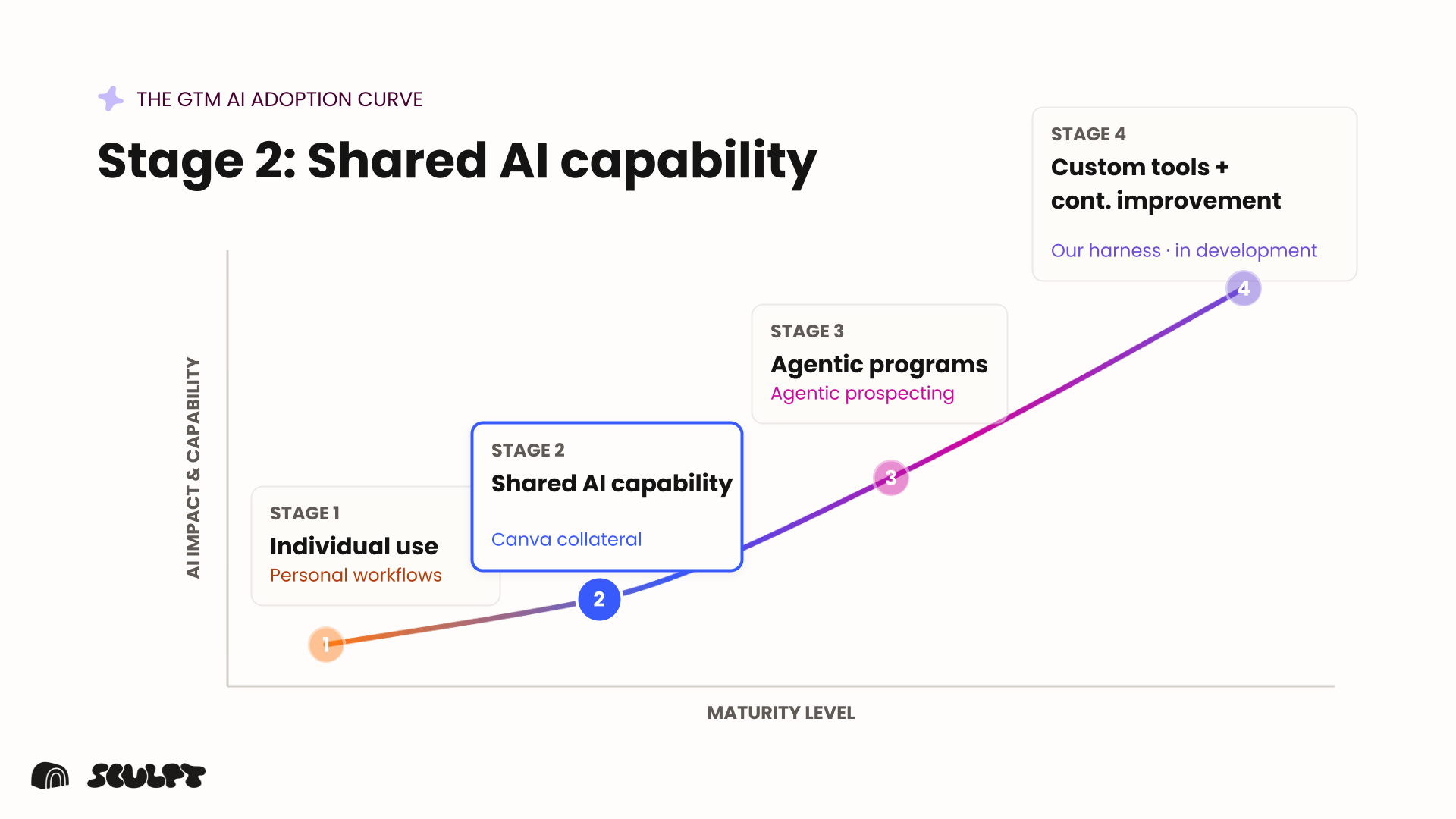
Stage 2: reps stop figuring it out alone.
Stage two is a shared AI capability, owned by RevOps or a GTM engineer, so reps stop figuring it out alone. That means skills, connectors and company knowledge, built once for everyone.
A skill is a reusable set of instructions the AI follows for a task. We started with data access, then centralized the skills:
Connected to: Salesforce, Gong, Snowflake and Canva.
Shared skills: a Salesforce field guide, first-call decks, pitch decks and customer QBRs.
Available to: every rep, in Claude or Codex, from day one.
It’s baked into onboarding too. New reps get it as a core part of their first 90 days.
The easiest win was explaining our Salesforce data
Salesforce data is messy. We have seven different ARR fields.
So alongside the Salesforce MCP, we wrote a skill that tells the agent which ARR field to use, and which field to use when you pull a region. MCP is the connection that lets an AI tool work with Salesforce.
It was one of our most successful launches. Make it dead simple, and give reps direction.
The aggregation trap
Once the agent understands Salesforce, you plug in Gong and Snowflake. Now you can summarize every call, every account and every QBR.
At some point you’re summarizing the summaries. In the talk, this is the slide with Admiral Ackbar on it.
This is the aggregation trap: summaries everywhere, long docs nobody asked for, and no work actually done.
The summary is not the work
The raw material.
↓
Ready in seconds. Still not a deliverable.
THE AGGREGATION TRAP
↓
Saved in Gmail for the rep to review and send.
The call summary is ready. You still owe the follow-up.
The way out is to stop aggregating data and start accomplishing tasks. Take the follow-up: you have the transcript and the summary, and the follow-up is still a blank page.
So the skill saves a follow-up draft in Gmail, and the rep reviews it and hits send. No copying and pasting out of Claude.
I walked through that setup in From helpful answers to finished work.
Our best deliverable is our own product
Where we’ve had the most success finishing work for reps is the Canva MCP. I’m contractually obligated to call it my favorite feature. It’s also true.
First-call decks: built from our templates with Gong insights and Salesforce data, in one skill.
Pitch decks: the same, plus Snowflake usage data.
CS QBRs: a deck that took 30 minutes to an hour now takes one skill.
It goes beyond decks: digital sales rooms, customer leave-behinds and social content.
I wrote about why deliverables get adopted in The AI workflow works. Why is nobody using it?
Stage 3: one hire can’t carry an agentic program
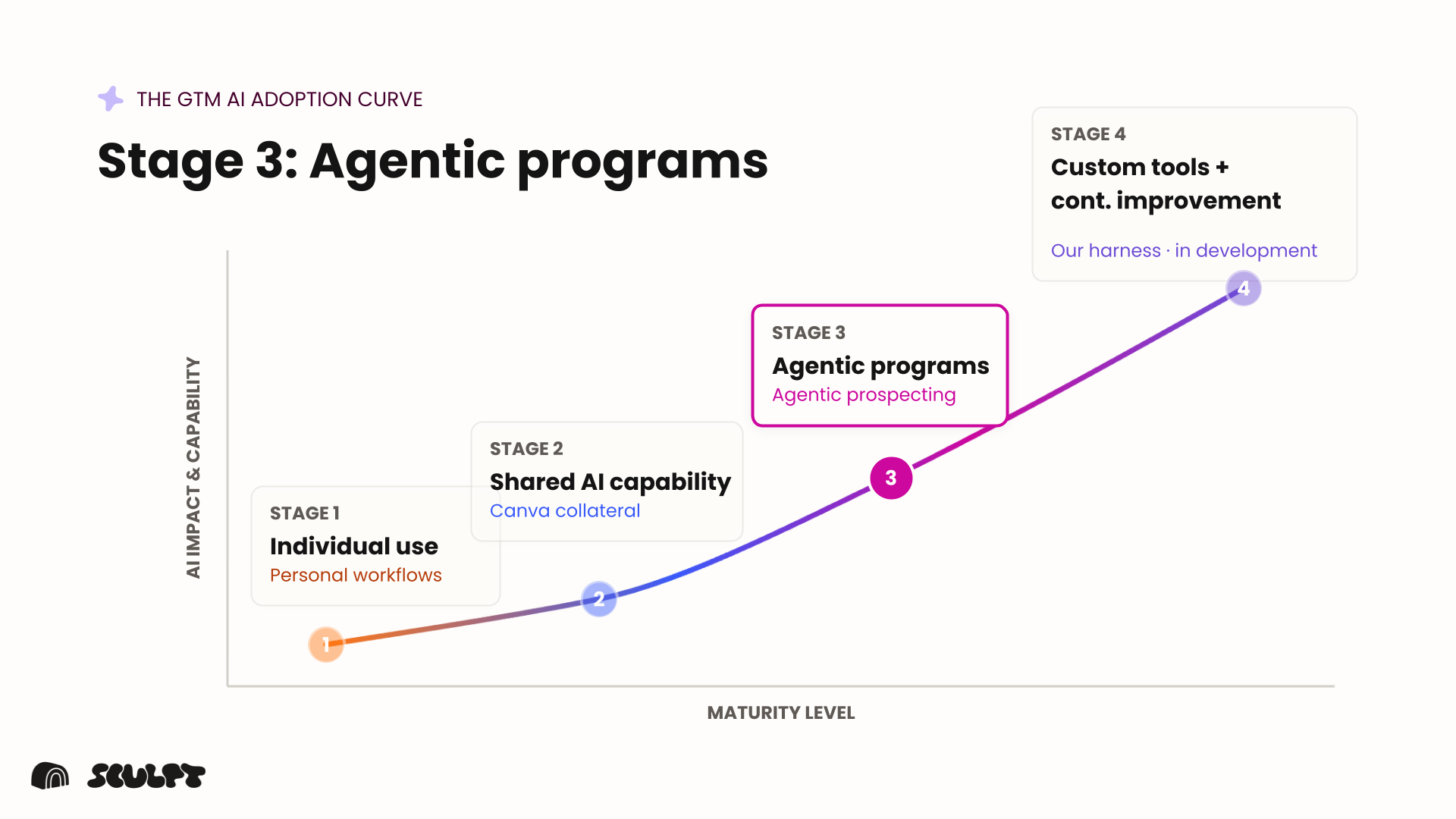
Stage 3: where it gets more technical.
Stage three is agentic programs, and building them takes real lifting. The first move almost everyone makes is to hire an agentic lead.
You go find your knight in shining armor. Sales background, ops chops, knows every tool, startup on the résumé.
Then you wait for the millions in pipeline, because you’ve seen the LinkedIn posts. It’s a trap. Again.
And this one’s more expensive, because it comes with a salary.
One hire, five other jobs
Here’s the job you actually hired them into:
Clean the CRM, which I’ve still never gotten our sellers to do
Get everyone to agree on a sales play
Source the tools
Get systems support
Align stakeholders across every region
And drive pipeline in month one.
Check three foundations before you hire
Before you hire an agentic lead, check that three foundations are in place. Or hire someone to build them, and give it time.
What ready looks like
BEFORE STAGE 3
Data + systems
Clean CRM, usable data, the right tools, committed Salesforce admin capacity.
Sales motion
Defined ICP, message, play and outcome. Leadership and the field aligned.
Organization
The lead, a senior BDR partner and an executive sponsor who can unblock decisions.
If these are missing, hire for the foundation work and allow time for it.
Agents can scale a motion. They can’t agree on one for you.
Then put the right people around the lead. We think of it as a pod: someone on systems and data, a BDR or prospecting lead with enough pull to define the motion, and an executive sponsor above.
Turns out you need more than one knight.
Stage 4: own the tool so you can improve the work
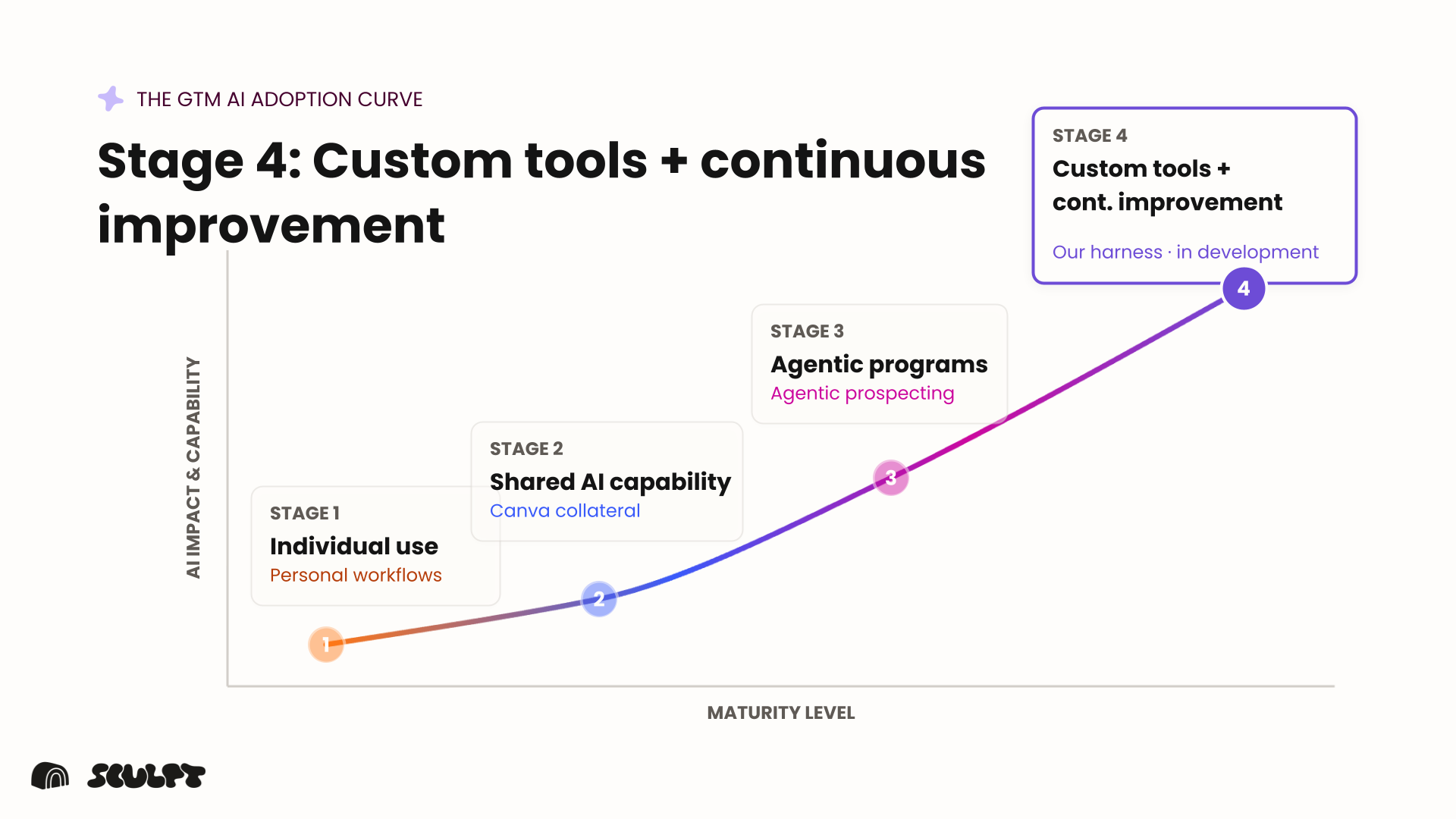
Stage 4: early days for us.
Stage four is custom tools and continuous improvement. The signal I’d point to is hiring: companies are putting software engineers inside go-to-market teams.
When I built the talk, Anthropic, OpenAI and Vanta all had roles like that open. The pattern is agents, evals and feedback loops, built inside the revenue team.
Evals, short for evaluations, are repeatable checks that hold the work to a standard.
Our first project with real engineers on it is a custom GTM harness, built on our Claude and Codex workflows. A harness is the software around an AI model: its context, tools, permissions and actions.
It’s still in development. I wrote about it in What is a harness, actually?
Why build our own? Three reasons:
It knows our motion. Ask who to contact at an account, and it answers from the company and the play.
It does more, safely. Inside one specific workflow, we can allow a Salesforce update we’d never allow in a general tool.
It spends smarter. A small model for the lookup, a stronger one for account strategy.
That last one matters more than it sounds. AI spend is going to hit your P&L sooner or later.
The trap at this stage is chasing the hot new tool before the foundation and evals are ready.
Because we own the harness, we have the tracking. That’s what could turn agentic prospecting into a real growth experiment: launch variants, check they’re on the right play, measure what moved.
We’re not there yet. But we’re a lot closer than one person with a Clay table.
Four stages, what worked, what to watch for
If you keep one thing from this post, keep this table.
Stage | What’s working | Watch for |
|---|---|---|
1. Individual use | Reps using AI every day for meeting prep, research and follow-ups. | Calling yourself AI-native because every rep has a license. |
2. Shared AI capability | Shared skills for Salesforce data, customer decks and follow-up drafts. | The aggregation trap: summaries everywhere, deliverables nowhere. |
3. Agentic programs | Agentic prospecting, built step by step from eligibility to BDR handoff. | The agentic lead trap: expecting one hire to carry the program. |
4. Custom tools | Early days: our custom GTM harness is in development. | Chasing the hot new tool before the foundation and evals are ready. |
Where I’d start
You don’t need to be at stage four. What matters is knowing what your next stage needs before you jump to it.
So point at the curve and be honest about where you are. Then take the step that stage is asking for:
At stage 1: find out where your reps really are before you write a strategy.
At stage 2: pick one deliverable and carry it past the summary.
At stage 3: check the three foundations before you hire the lead.
At stage 4: get the foundation and evals ready before you chase the tool.
Stop asking what an agent can do. By stage four, you’ll know.
Robert