

Business Breakdowns · GTM AI
A million recorded events can still leave a software team unsure what to fix next.
That’s the part of PostHog’s business I find interesting. Getting installed is the easy win. The growth comes later, when a team uses the data to make a decision it trusts and comes back with the next question.
If you haven’t used it, PostHog is a set of tools for understanding what people do inside a software product:
Product analytics: shows which steps people complete.
Session replay: lets a team watch individual visits.
Feature flags and experiments: release a change to some users and measure what happens.
The tools can share the same customer activity, which gives a team a reason to move from one to the next. PostHog’s product overview.
Its homepage now goes a step further and pitches that data as context for AI agents: connect your product, ask what’s happening, and use the answers to improve it.
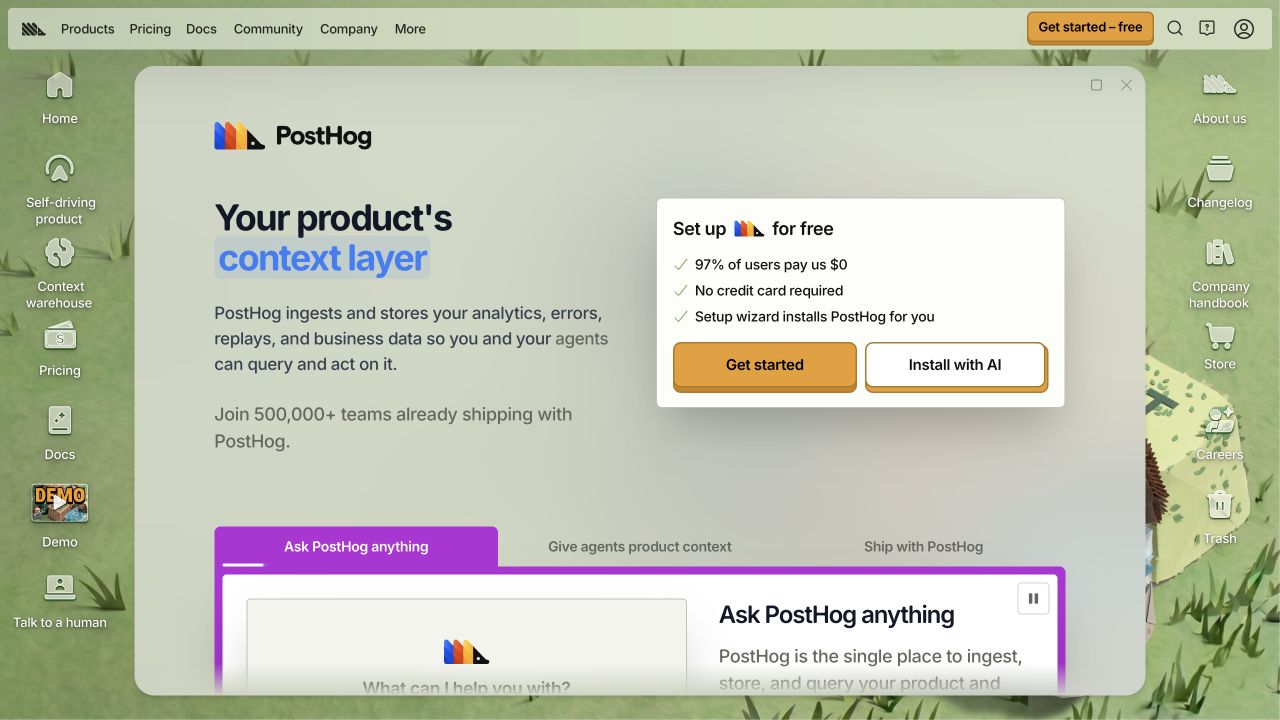
PostHog’s homepage, October 2, 2026.
For a founder or growth lead without an analytics team, that’s an appealing promise. So the business question is what happens after the tracking works.
I’ll end with a test I’d run: helping a small B2B team make its first activation decision.
THE SHORT VERSION
How it makes money: free to start, then pay for usage. A busy account can still pay nothing.
Where growth comes from: a customer finds an answer they trust and comes back with the next question.
What I’d test: whether a short session with a person beats the AI tools alone at getting a team to that first decision.
What I checked: PostHog’s public pages, docs and pricing as of October 2, 2026. Prices here are analytics only, before other products, discounts or taxes. I haven’t run the AI wizard or the test I propose below.
A million events can still be worth zero dollars
PostHog lets you start without a credit card. Every product has a free monthly allowance, including one million analytics events and 5,000 session recordings. Past that, you pay for what you use, product by product. Current pricing.
Here’s what analytics alone costs at the published rates:
Events per month | Analytics bill |
|---|---|
1 million | $0 |
1.2 million | $10 |
2 million | $50 |
The first million events are free. After that, each one costs $0.00005. Rate table.
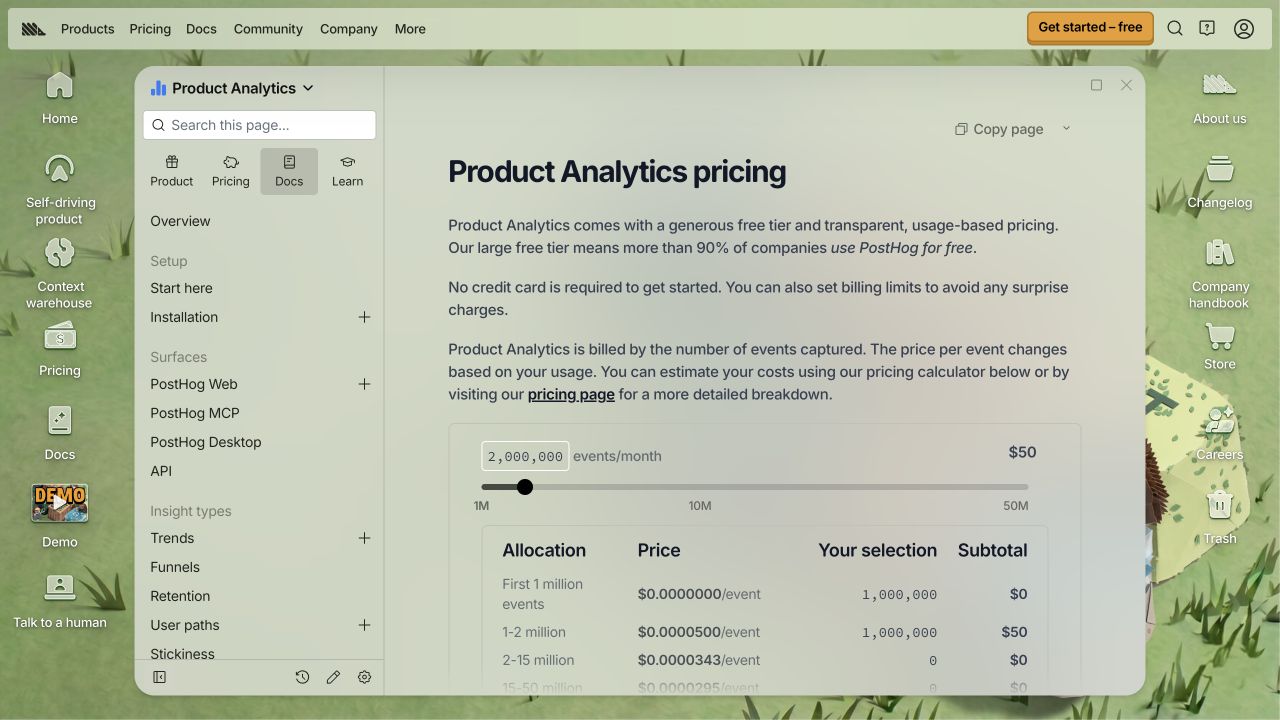
PostHog’s pricing calculator set to two million monthly analytics events, October 2, 2026.
That’s generous, and it changes how you should read an account. An event is a recorded action, like a page view or a completed signup. It isn’t a customer, a sale or a good decision.
One person can fire the same event twice, so four “report created” events can mean three people got there.
So a busy account isn’t automatically a valuable one. One team can make excellent decisions inside the free allowance. Another can run up a bill recording the same unhelpful event over and over.
PostHog seems to know this. Its cost-optimization handbook tells staff to help customers cut wasteful spend, even when revenue falls in the short term. A badly set up account is a retention problem waiting to happen.
So the growth mechanism is more specific than “more data, more revenue.” Customers have to get enough from the analysis to keep collecting the right data, keep using the product and, where it helps, pick up another tool. Installation guarantees none of that.
Where the value starts
Tracking is in place.
↓
Data arrives. The bill can still be $0.
VALUE STARTS HERE
↓
↓
↓
The first two steps can cost the customer nothing and tell them nothing.
The first useful question introduces the next product
Picture a small company selling project-management software to agencies. It has plenty of trial signups, but fewer teams are creating a first shared project. The founder wants to know where people get stuck.
A funnel is a chart of how many people make it through each step of a sequence. Here it would run from signup to creating a workspace, inviting a colleague and creating that first shared project.
PostHog lets the team see who dropped out at each step, then open the relevant sessions. How PostHog funnels work.
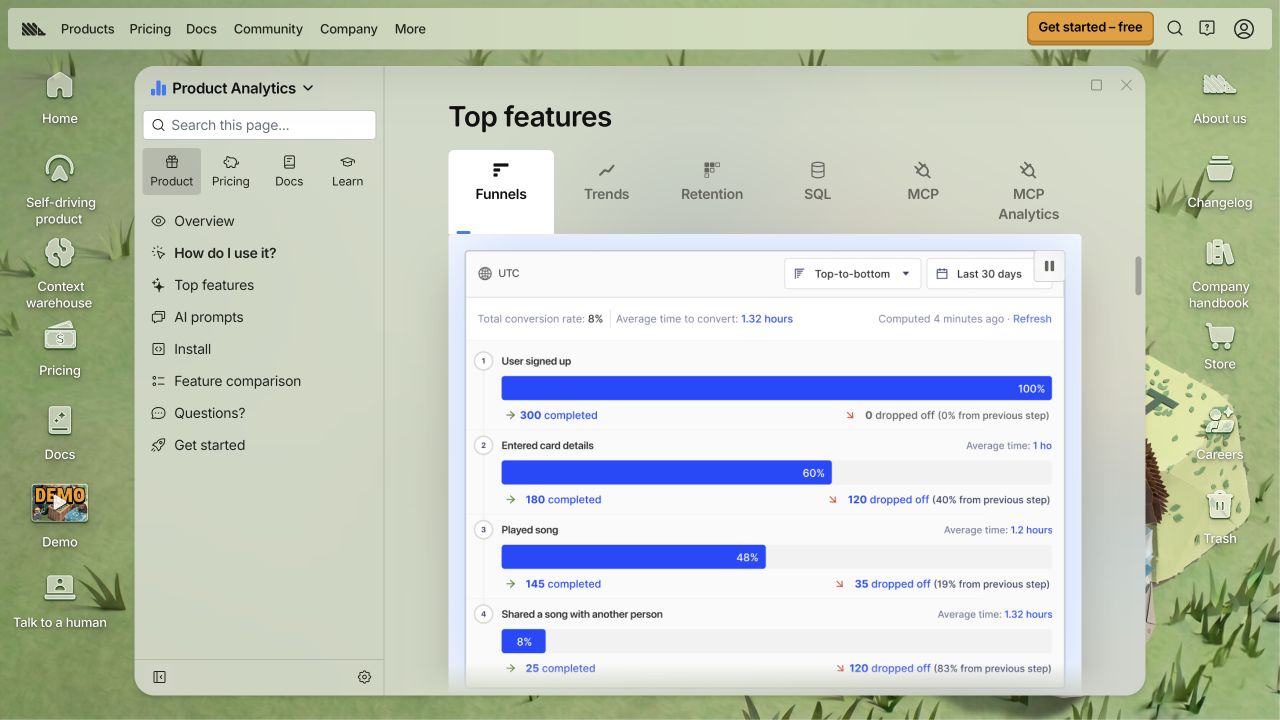
PostHog’s public funnel demo, October 2, 2026.
That’s a natural reason to try session replay. The chart shows where people stop. It can’t show why.
One question, three products
Shows where new teams stop.
↓
Shows what they were doing when they stopped.
↓
Tests whether the fix helped.
Each product answers the question the last one raised.
I like this as an expansion path because nobody has to get excited about a longer features menu. The customer just needs help with the next part of the investigation.
It also raises the bar for what counts as adoption. Switching on replay and never watching a session is weak evidence. Using replay to understand a stalled trial, then checking whether the change helped, is a milestone worth counting.
One caution: a drop-off can also be a tracking problem. Someone still has to check what the events mean.
AI already does part of the onboarding
I can’t just recommend that PostHog use AI to help people get started. It already does.
AI wizard: reads a codebase, installs PostHog, adds tracking and builds first dashboards.
Starter prompts: create insights and dashboards for common business questions.
Self-driving, in open beta: scheduled scouts flag issues, and some reports arrive with a pull request ready to review.
The early numbers are encouraging. In a June 2026 write-up, PostHog reported that 14.2% of wizard users converted to paid, against 2.6% in its comparison group.
Those are PostHog’s own numbers, and the post doesn’t say how the two groups were chosen. I read them as a direction, not proof.
So anything I propose has to beat an automated baseline that keeps getting better. The customer still has to work out whether the funnel counts the right people, whether the problem is real, and who owns the decision. That’s where a person might help.
What I’d test: help a B2B team make its first activation decision
My hypothesis: a short, focused session gets a small B2B team from collected data to a decision it trusts, and those teams are more likely to stay and pay.
Activation is the moment a new customer first gets real value. In the project-management example, that’s creating the first shared project.
Who I’d pick. Small B2B software companies with:
A live self-serve trial
A recently changed onboarding flow
Usable production events
A named owner for activation
Room to ship a change in an upcoming release
A side project with no users has nothing to investigate yet.
The offer: a checked activation funnel, an evidence-backed explanation of one problem, and a defined next change to evaluate. Sometimes the answer will be that the measurement is too weak to support a product change. That counts.
PostHog already sells help, including an $80 half-hour consultation and bigger implementation projects. So this isn’t a new idea for them. It’s a narrower one.
What AI does, with the customer’s permission:
Inspects event definitions and queries the signup cohort, meaning everyone who signed up in the same period
Prepares a saved funnel with its time window, filters and links to the evidence
Flags relevant session recordings for review
Drafts a tracking fix instead, if the completion event is missing
What a person does:
Checks the analysis before the customer sees it
Runs one session to settle disputed definitions, pick the next action and assign an owner
Leaves code changes to the customer’s engineer, who approves and tests them
The agent would connect through PostHog’s MCP, the connection that lets an AI tool work with PostHog. Reading is enough to investigate. Saving the agreed funnel needs write access, and an administrator has to switch AI access on first.
The customer leaves with saved work in its own project and a plan for measuring the change. Not another presentation to interpret.
The pilot. I’d start with ten qualified, willing companies. All ten get the same checked analysis and normal onboarding, AI tools included. Five, picked at random, also get the session and a limited follow-up.
A proposed pilot
10 small B2B software companies with a live trial.
↓
All 10 get the checked activation analysis and normal onboarding.
↓
5, picked at random, also get the focused session.
↓
A decision the team used, then retained paid usage.
Expand only if the added help pays back inside the agreed window.
Ten accounts will show whether the offer is useful and how much repair work it creates. They won’t prove a conversion lift. That takes a bigger group and an observation period sized to the outcome.
What I’d measure:
At 30 days: a decision the team actually used, and continued use of the analysis.
At 90 days: retained paid usage and contribution after serving the account.
Supporting sign only: a second product switched on.
A good outcome could even lower spend, by stopping redundant events.
The math. Small analytics bills leave little room for expensive help, so the cost needs a cap.
Two terms first. Contribution margin is what’s left of revenue after the cost of serving the customer. Payback is how long the added profit takes to cover the upfront cost.
Per company | Cost |
|---|---|
Selection and analysis review: 20 minutes at $75 an hour, plus $5 of AI and tooling | $30 |
Session and follow-up: one hour at $75 an hour | $75 |
Assisted version, total | $105 |
If the session adds | The extra $75 pays back in |
|---|---|
$10 a month | A little over 9 months |
$50 a month | About 2 months |
That assumes an 80% contribution margin, before churn. These are my planning assumptions, not PostHog’s costs. And the math has to use the revenue the help adds, not the account’s whole bill.
Decision rule:
Expand if the added retained contribution covers the full cost inside the payback window.
Productize if the prepared analysis does just as well without the session.
Fix tracking first if bad tracking turns out to be the usual blocker.
What to take from this
Usage isn’t value. Count the decisions a customer makes, not the data they send.
Find the first trusted decision. That moment, not the install, is where retention starts.
Price help against what it adds. Compare a person’s time with the extra revenue, not the whole bill.
If you’re evaluating PostHog for a small team right now, start with one decision that’s due soon. Define the completion event, check a few underlying sessions and save the analysis with its filters. Then ask a colleague to reproduce the finding before you change the product.
Robert