

Business Breakdowns · GTM AI
Higgsfield has taken AI video by storm. I work at Canva, so my interest here is selfish.
I want to know what they’re doing well and why people are buying it. When someone nearby is growing this fast, I’d rather understand it than have opinions about it.
Disclosure: Canva also makes creative tools. These are my own views, from the outside, using public information and a free account.
Updated October 8, 2026, with Higgsfield’s $1 billion run-rate announcement.
The numbers first. On September 29, Higgsfield said it had crossed $1 billion in annualized revenue, 18 months after launch and about 20 times where it was a year earlier. Six weeks before that, Reuters reported a $400 million raise at a $5.4 billion valuation, four times its January price.
It now counts more than 32 million users and nearly 1 million paying subscribers. The CEO says the company has been breaking even on cash flow for the past couple of months.
Higgsfield in September 2026
$1B+
annualized revenue, up about 20x in a year
~1M
paying subscribers, out of 32M+ users
$5.4B
valuation, up from $1.3B in January
Company-reported figures. Revenue and subscribers from Higgsfield, September 29, 2026. Valuation via Reuters, August 17, 2026.
Those are the company’s own numbers. The $1 billion is its last four weeks of revenue multiplied by 13, so roughly $77 million in four weeks, not a year of sales. Still, something is working.
Here’s my read on what that is, what it was like to use, and one test I’d run if I were on their growth team.
THE SHORT VERSION
Why people buy: they can see a finished ad before they write a prompt, from a brand that feels native to AI.
What Higgsfield does well: sells the job instead of the model, puts many models in one place, lets creators do the distribution, prices by output and looks the part.
Where it looks fragile: the first usable job is harder than the gallery suggests, and renewal depends on the second campaign.
What the latest numbers add: customers are buying past their plan. Subscriptions went from more than 90% of revenue to just over 60%.
What I’d test: a campaign package that helps a small agency finish its next client refresh without a rescue call.
What I checked: an AI assistant ran my tests on the Free Plan on October 2 and 5, 2026, with no purchase and no teammates invited. Product and pricing details come from Higgsfield’s public pages. Traction figures are the company’s own, from its September 29 announcement and Reuters.
Six things I think they’re doing well
1. It sells the finished job, not the model
Higgsfield organizes itself around jobs like product photography, ads and cinematic production. Marketing Studio is the clearest example. Its introduction shows a path from an existing template to a version with your own product in it.
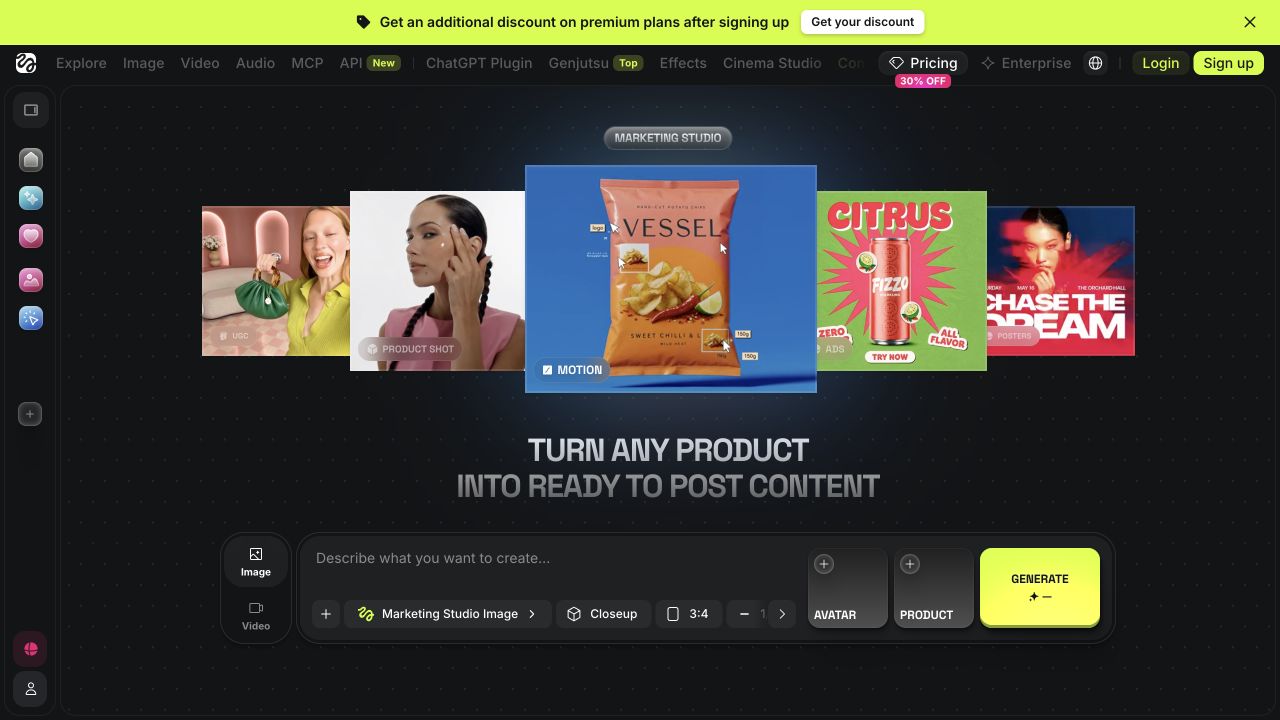
Higgsfield’s Marketing Studio examples, October 2, 2026.
Higgsfield says you can:
Import: pull product details from a link or your own photos.
Reuse: apply the same product across templates.
Edit: change individual text or image layers in a layout.
This is the part I think explains the buying. Someone staring at an unfamiliar AI model has to imagine a use for it. Someone looking at a product-shot template can already picture the deliverable.
The question changes from “What should I prompt?” to “Could this treatment work for my product?”
2. It doesn’t make you pick a model
Most people don’t want to track which lab shipped the best video model this month. Higgsfield’s site lists models from several labs, including Kling, Veo and Seedance, next to its own tools like Soul. Its plan guide says higher plans unlock every model on the platform.
My own test leaned on that. The model that animated my clip, Minimax Hailuo 02, isn’t Higgsfield’s. I picked it from a menu.
One subscription, whichever model fits the job. That’s a real reason to buy.
3. Creators do the distribution
Higgsfield recruits people to show the work. Its Creator Partnership Program gives accepted creators a plan, credits and early access, and asks them to mention Higgsfield when they use it.
The output is the ad. Worth remembering, though, that a great demo may come from a supported partner.
4. The price grows with output
Higgsfield sells credits. Make more, pay more. It’s the same alignment I liked in beehiiv’s pricing, where the bill grows with the customer’s audience.
The latest numbers suggest it’s working. Subscriptions used to be more than 90% of Higgsfield’s revenue. They’re now just over 60%, as on-demand usage has grown. People are buying past their plan.
There’s a limited free tier and no trial period. Here’s what the Team plan showed with five seats on monthly billing:
Team plan, five seats, monthly | Per seat | Five seats |
|---|---|---|
First month, promotional | $69 | $345 |
Renewal | $79 | $395 |
Monthly credits | 1,000 | Pooled across the workspace |
Team allows two to nine members. Prices are before taxes, from Higgsfield’s pricing page on October 2, 2026.
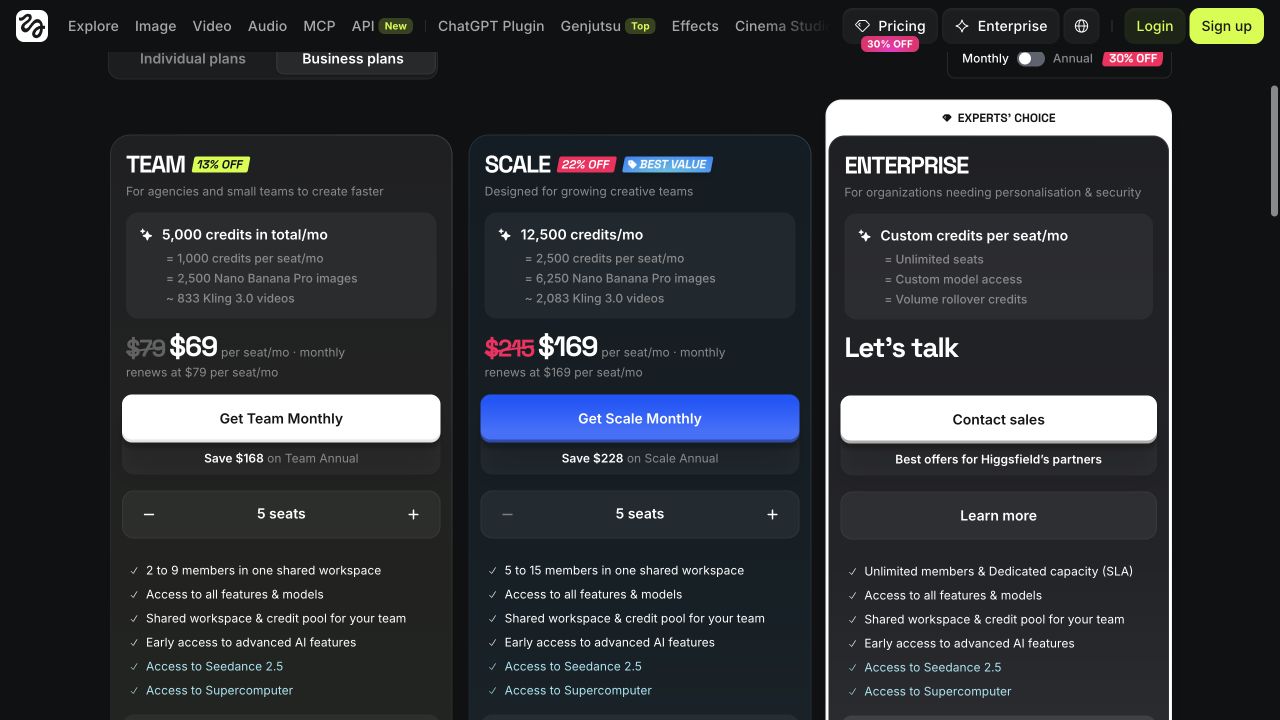
Team pricing with five seats and monthly billing selected, October 2, 2026.
How credits get spent matters as much as the sticker price:
Varies by model: cost depends on the model and the settings.
Retries cost: re-rolls and upscaling use credits too.
“Unlimited” has limits: it covers manual use on the website, not MCP or other automation.
Trackable: usage history shows what a project consumed.
MCP is the connection that lets an AI tool work with Higgsfield. So an automated creative workflow pays standard credit rates, even on a plan with unlimited models.
5. It’s moving up to teams
Business plans add shared workspaces and pooled credits, and higher tiers add capacity and controls. The Team page leans on shared assets, prompts and review.
At the top end, Higgsfield offers enterprise onboarding around a team’s first real project, with a dedicated AI educator. And the founder told the Financial Times the new funding will speed up the move upmarket, according to The Next Web.
The September numbers point the same way. Higgsfield says revenue under contract from business customers is up tenfold since June, driven partly by direct-to-consumer brands making AI ads. It also says it powers campaigns for 390 of the Fortune 500. I can’t check that one.
6. The brand feels like an AI company
This one is harder to measure, but it’s the first thing I noticed. Higgsfield looks like it was born in this era, not adapted to it.
Some of what creates that feeling:
The homepage is the product: a dark page of moving video, where nearly every example has a Recreate button.
The names have attitude: Soul, Genjutsu, Supercomputer. Not “AI Video Generator Pro.”
The culture is on display: a Global Film Festival with public submissions, and community projects that show their prompts and assets.
It calls itself an “AI-native creative suite,” and everything on the page backs that up. Buying it feels like joining something current.
For a creative tool, I think that matters more than most growth people like to admit.
What it’s like to buy: my first video took two sessions
I wanted to see what a first job really takes. So I had an AI assistant run the test, signing up the way a small team would.
Session one, October 2. The welcome screen advertised 50 credits for a business email. The Free Plan account showed 10, and I don’t know why the two differ.
The first job was a short product shot for a made-up office-supply brand. The default video option cost 60 credits.
The cheaper models each wanted something extra, like a start frame or reference footage, and one wasn’t available in the US. No video. No credits spent.
Session two, October 5. This time the job was an “Under the AI hood” visual for this newsletter. I started from a still made with OpenAI’s image generator and had Higgsfield animate it.
A six-second request cost 6 of the 10 credits and came back as a silent clip.
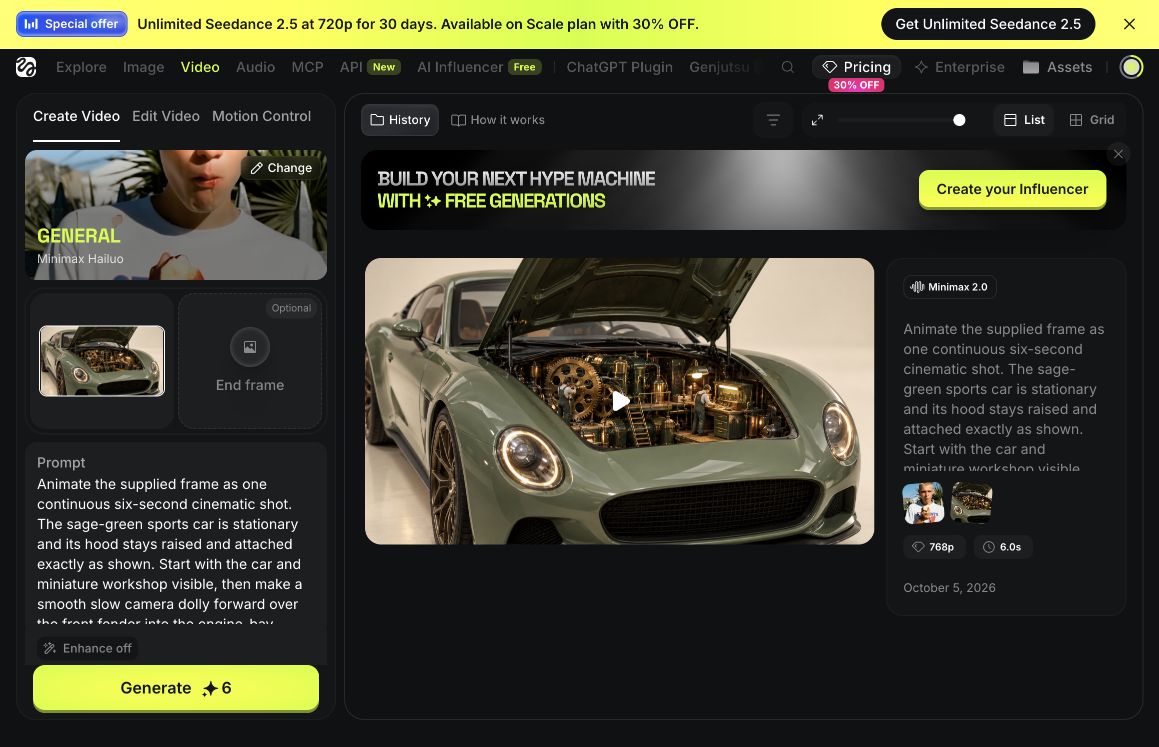
The finished generation in Higgsfield’s History, October 5, 2026. Minimax Hailuo 02, six seconds at 768p.
First-pass clip. Still made with OpenAI, animation by Higgsfield. Not final creative.
It’s a decent first pass. The car, the raised hood and the two technicians hold together. But the camera stops short of the workshop, and the workers and gears move more than I asked for.
So here’s the gap I noticed. The gallery sells a finished result. The first session asks you to choose a model, manage credits and bring source material.
None of that stops a motivated buyer. But a playable file still isn’t an approved one.
The second campaign is where I’d look
For an agency, the unit of output is an approved asset inside a campaign. A folder of twenty interesting alternatives can still leave most of the job undone.
Higgsfield’s own customer material has a telling example. A production studio called Sinecera describes getting a still image art-directed and approved before animating anything, and using shared projects to keep a consistent look.
It’s Higgsfield’s own case study, so I’m ignoring the savings claims and looking at the process. And the process makes sense. If the product, setting or look is wrong, generating more versions just multiplies the wrong answer.
That’s the difference between a first project and a second one. A good first experiment can sell a subscription. A repeatable process gives an agency a reason to keep paying, bring in colleagues and buy more capacity.
The first campaign sells it. The second keeps it.
1. See a template you like
2. Add your product
3. Get a clip worth showing
4. Subscribe
1. A new client brief arrives
2. Reuse approved assets and settings
3. The client approves
4. The team keeps paying
A good first clip earns the signup. A repeatable process earns the renewal.
That’s my hypothesis. I can’t see their retention numbers, but the September announcement gets closer.
Higgsfield says direct-to-consumer brands keep generating because ad production is iterative: launch a campaign, test new versions, adapt the winners for other audiences. That’s the second campaign, described by the company itself. And the shift toward on-demand revenue says customers are doing more than their plan covers. It’s spend, not proof of renewal, but it points the right way.
It also changes the number worth watching. A workflow can save production time while spending more on generation, so I’d track cost per approved asset: the subscription share, every generation attempt, editing and review time, divided by the assets the client accepts.
Six clips, two approved
Six generated. Two approved. You paid for all six, so divide the full cost by two.
I made the same argument about AI workflows in What is a harness, actually?, where the number is cost per accepted task.
The logic applies to Higgsfield’s own growth too. More credits burned means more revenue, but it doesn’t mean the customer is succeeding. A customer repeatedly paying to repair the same problem is a particularly fragile expansion story.
What I’d test: help a small agency finish its second campaign
My hypothesis: a small agency that leaves its first campaign with a reusable package will finish the next one on its own, and keep paying.
Who I’d pick. Small agencies that:
Make recurring paid-social creative for product businesses
Are newly paying and have tried a generation
Have a real refresh due within a month
Can supply approved product assets and a named reviewer
That’s close to where Higgsfield says its demand is: direct-to-consumer brands producing and testing ad variations.
The offer: bring one approved brief and leave with a reusable campaign package, then use it to finish the next refresh.
What’s in the package:
Two storyboard directions
Approved source imagery
Three short draft variations
A production recipe: the settings, accepted assets and review decisions
Who does what
Assembles product facts, permitted claims, references and two storyboard directions.
↓
Approves a direction and a generation budget.
↓
Generates a small batch through Higgsfield’s MCP. Logs prompts and credits used.
↓
One limited session on product accuracy, taste and continuity.
↓
Takes the package and recipe. Owns client approval and publishing.
Green steps are AI. The test is what happens next: a new campaign with no live session.
The AI keeps a source link beside every factual claim and flags what’s missing. It doesn’t get to turn a product description into an invented testimonial.
Higgsfield documents generation, credit checks and asset access through MCP. The brief, review record and packaging around it would need building. Final edits, like exact logos or approved text, may still happen in the agency’s own editor.
The handoff is the point. At the next refresh, the agency should have a usable package and recipe, not an obligation to book another rescue call. If it still needs the same level of help, I’ve built a production service with very different economics.
The pilot. Take 24 eligible agencies and offer the package to half at random. The other half get existing onboarding, and both keep normal support. That’s enough to surface delivery problems and estimate costs, not to prove a conversion lift.
The one number I’d watch: the share that finish a separate, client-approved campaign in Higgsfield within 45 days, with no further live session. A second variation of the assisted campaign doesn’t count.
Also worth tracking:
Human hours and generation spend per approved asset
Whether the agency is still paid and active at 90 days
Real added revenue, as opposed to a plan upgrade that replaces existing spend
I’d write the acceptance criteria down before starting, so the assisted group can’t win by shipping easier work.
Decision rule:
Continue if help produces more repeat commercial use, at a cost the added contribution can support.
Narrow if preparation helps but live support eats the budget.
Stop if the win depends on staff doing the client’s work, or the comparison group gets there unaided.
Contribution here means revenue minus generation costs, granted credits, preparation, review and support. The real margin and retention inputs would have to come from Higgsfield. Public prices alone can’t justify a delivery budget.
What I’m taking from this
Show the finished thing first. A template people can picture beats a blank prompt box.
Don’t make buyers pick a model. Making that choice painless is part of the product.
Let the work do the marketing. Output people want to share is distribution.
Look like what you are. A brand that feels native to AI makes buying feel current.
Watch the second job. The first clip earns the signup. Repeat work earns the renewal.
If you’re evaluating Higgsfield for your own team, run a smaller version of my test. Take one approved brief, keep the rejected attempts and review time in the cost record, and see whether a colleague can repeat the process for the next refresh.
That’s a better buying signal than the most impressive clip in the gallery.
Robert